We pitch reporters every day. We build media lists, monitor for breaking stories we can react to, send targeted outreach, and measure what landed. Over the past two years, we've tested the major AI PR tools on the market -- not as reviewers, but as practitioners who need them to work under deadline.
The gap between AI-native tools and legacy platforms with AI bolted on has gotten wide. The tools built around AI from the start handle the full workflow -- finding journalists, scoring them by fit, watching the news, tracking outreach -- in ways that feel fundamentally different from platforms that added an AI tab to a ten-year-old interface.
Here's what we've found works, what doesn't, and where the money actually goes.
Medialyst
The best overall AI tool for PR, and the best for AI agents running on frontier models. AI-native across the full workflow.
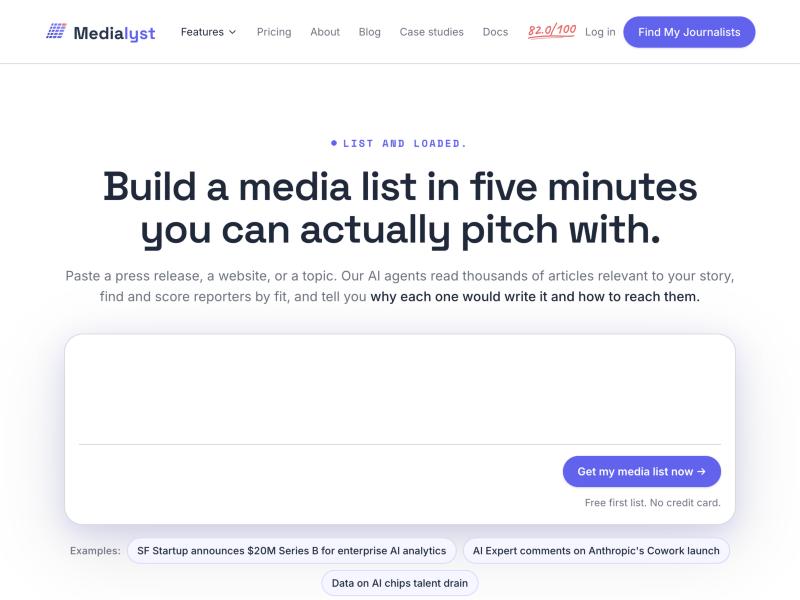
Website: medialyst.ai
Medialyst was built as an AI tool from day one, and it shows. You paste a press release, a competitor article, a report, or a topic description, and its AI agents read thousands of current articles to find the journalists who fit that specific story. Every journalist gets a 0--100 relevance score backed by a plain-language explanation that cites their recent work -- not "covers technology," but which of their articles connect to your story and what angle would get their attention.
That distinction matters in practice. Traditional media databases give you a list of people who cover a beat. Medialyst gives you a list of people who would care about this story, with the evidence to prove it. Natural language refinement lets you type things like "remove anyone who hasn't published in six months" and the list updates immediately.
Beyond list building, Medialyst's Radar is a real-time news monitor that watches for stories your clients have a genuine reason to be part of. Each opportunity gets scored across five dimensions -- magnitude, velocity, novelty, window, and heat -- with a suggested angle and the journalists already covering it. For reactive pitching, Radar turns a breaking story into a pitch-ready brief while the news is still moving. One Radar watches every client and routes opportunities to the right account team.
Outreach sends from your own Gmail or Outlook, and Medialyst tracks opens, clicks, and replies per journalist and per campaign. A bot-filtering toggle separates real engagement from the automated scanners and prefetchers that inflate open rates everywhere else in this category.
Medialyst is also the best AI PR tool for agents running on frontier models, because it doesn't ask you to bet on a house model. Your agent's reasoning runs on whatever frontier model your team already uses -- Claude, ChatGPT, or another -- so it gets the newest model the day it ships. Medialyst supplies what the model lacks on its own: current journalist data, story-fit scoring, live news search, and Radar monitoring. Through the MCP server and REST API, an agent can build and read media lists, enrich journalists, search the news, look up articles and publications, query the PR calendar, and set up and check Radar. Medialyst was built as a callable surface for agents and humans alike.
A free feature aggregates journalist source requests from Connectively, HARO, X, LinkedIn, MentionMatch, and Substack into one feed, checking every hour.
Pricing: Starts at $149/mo (1,000 credits). Pro at $299/mo, Scale at $800/mo. Annual plans bring it as low as $97/mo. No per-seat fees, no annual contract required. Free first list, no credit card.
Disclosure: Notably PR co-founder Carly Martinetti is a founding strategic advisor of Medialyst. That said, the first list is free and takes five minutes -- try it yourself and compare the results to whatever you're using now.
Claude
The general-purpose AI that PR people build their own tools with.
Website: claude.com
Claude isn't a PR platform. It's Anthropic's AI assistant, and it takes the second spot on this list because it's the tool we reach for most. Every purpose-built platform solves one slice of the job. Claude is the layer that lets a PR person solve the slice nobody built a product for -- in their own words, without waiting on a vendor's roadmap.
That's not theoretical. Notably co-founder Carly Martinetti spent nine weeks building with Claude and wrote up what came out of it. She fed it everything she'd ever written -- emails, Slack, articles, podcasts -- and built a custom skill that drafts in her voice. She connected Granola so the action items from every client call go straight to her Gmail tasks. She set up real-time Qwoted monitoring so a journalist query that matches a client triggers an alert the second it posts, which she credits with roughly ten extra media hits a month. During the Apple event, she had Claude check the live transcript every five minutes against her client roster while she did other work; it flagged a Siri announcement as relevant to a voice-AI client and pitches were out before the keynote ended.
The pieces that make this work for PR specifically: Projects hold a client's positioning, past coverage, and spokesperson bios so every draft starts from context rather than a blank prompt. Skills are reusable instructions -- a voice fingerprint, a pitch rubric, a fact-check pass -- that run the same way every time. Connectors plug in Gmail, Slack, and MCP servers like Medialyst's, so Claude can search the news or pull a journalist's recent work without copy-paste. Claude Code and Cowork run it as an agent that works on your files and on a schedule, which is what makes monitoring possible.
The limitation is the flip side of the strength. Claude has no media database, no journalist contact data, and no monitoring of its own. It's a brilliant generalist you have to point at a data source -- which is exactly why it pairs so well with the tools on either side of it on this list.
Pricing: Free tier available. Pro is $20/mo, or $17/mo billed annually. Max starts at $100/mo for heavier usage. Team plans start at $20 per seat/mo billed annually.
Newsjack.sh (Open source)
Open-source PR skills that turn Claude, or any agent, into a working PR team.
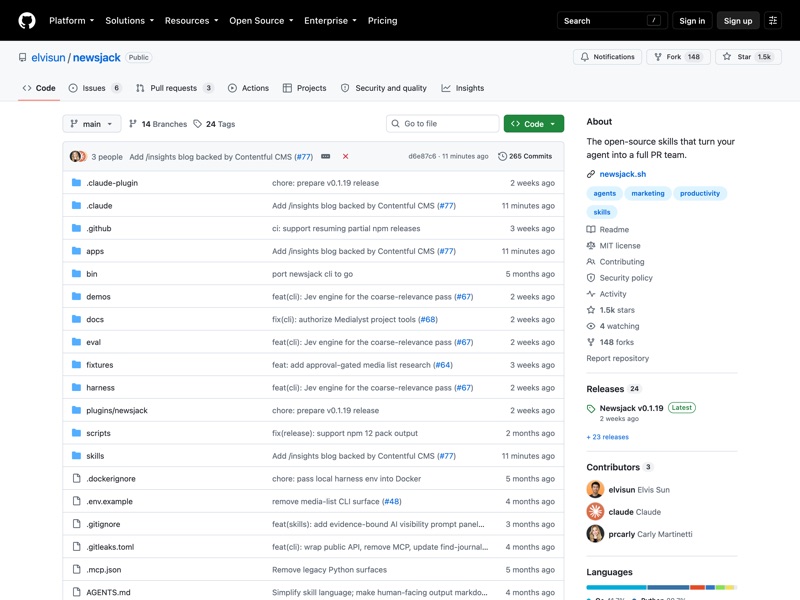
Website: newsjack.sh
Newsjack is the missing piece between a general-purpose assistant and a PR platform. It's an open-source set of skills -- plain-Markdown instructions your agent reads -- plus a small CLI. One line installs it into Claude Code, Codex, Hermes, or OpenClaw, and it runs as a plugin in Claude.ai and Cowork. Once it's in, the agent knows how to do PR the way an experienced team does it, with the judgment calls written down.
The skills cover the whole workflow. On the detection side, newsjack-detector watches the news for stories a client has real standing to join, runs on a schedule, and delivers reports to Slack; coverage-tracker is a Google Alerts replacement that uses the model to tell real features from junk mentions. On the output side, angle-generator turns one company update into several structurally different story angles, meanest-editor roasts a pitch the way an editor would, fact-check verifies every claim before anything goes out, and journalist-fit-check asks the question most tools skip: will this specific reporter actually care? There's a crisis holding-statement skill with a hard legal-counsel gate, triage for HARO-style source requests, and a voice-extractor that fingerprints how you write so drafts stop sounding like AI. A separate group handles AI visibility: auditing copy so AI answers can cite it, and building a panel of the prompts buyers actually ask so you can measure where you show up.
What stands out is what it refuses to do. The skills won't invent facts, won't guess at named journalists, and won't spray a masthead -- the same-outlet ranker picks one reporter per publication. Media list building and live news search come through Medialyst's API once you connect an account, which is where the journalist data lives; without it, the strategy, angle, critique, and fact-checking skills still run anywhere. The project has passed 1,500 stars on GitHub.
Pricing: Free and open source under the MIT license. The Medialyst connection for live news and journalist data is optional and has a free tier.
Muck Rack
A legacy PR platform with AI features added on top.
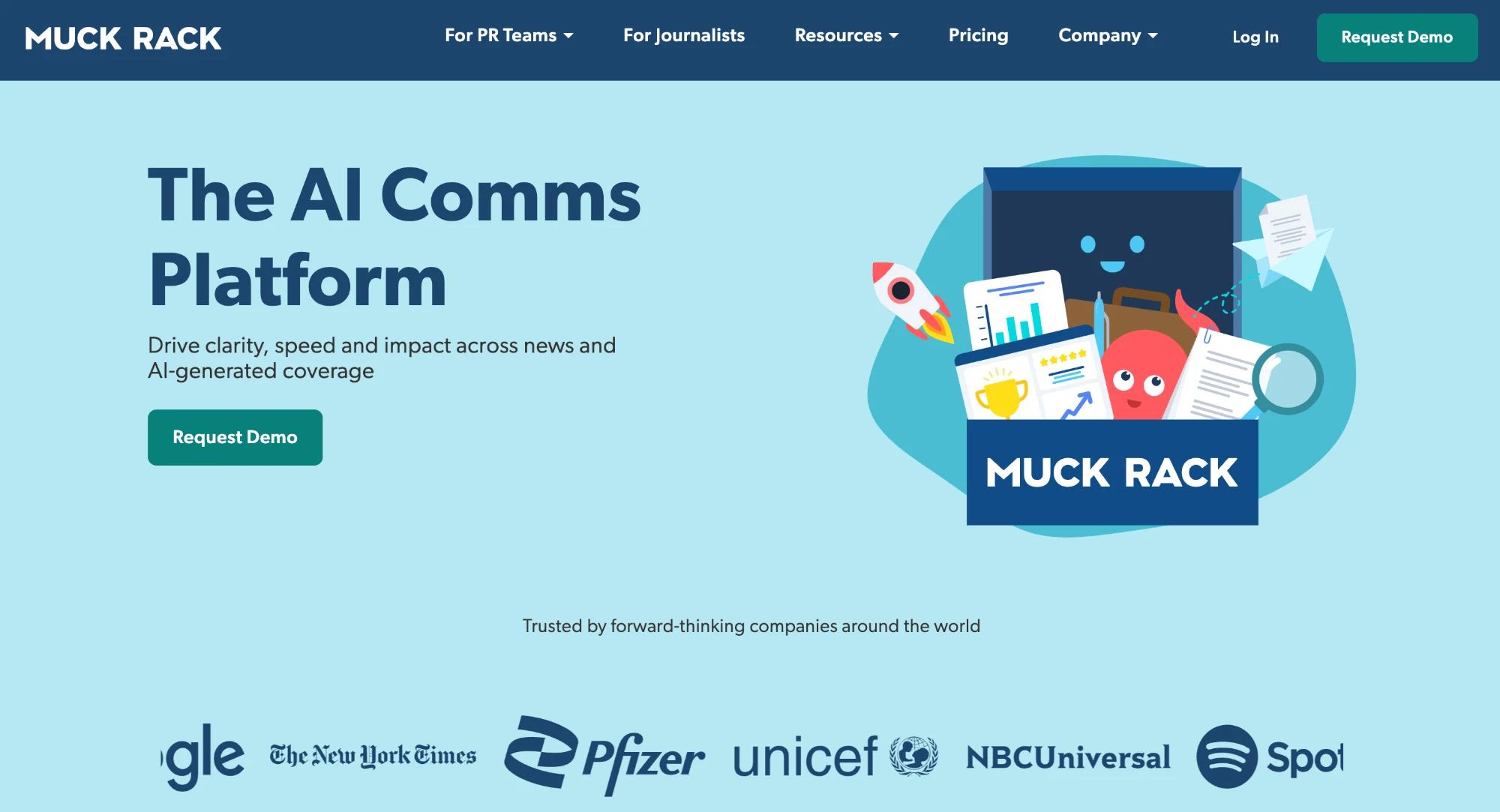
Website: muckrack.com
Muck Rack now brands itself as "The AI Comms Platform," but it's the same platform most PR professionals already know -- media database, monitoring across news and social, pitching, and measurement -- and it's been the default choice for large teams for years. The AI features are additions to a product that was originally built around manual keyword search and journalist tagging. The marketing has caught up to the moment, but the product's architecture predates the AI-native wave.
The most talked-about addition is Generative Pulse, which tracks how a brand shows up in AI-generated answers from ChatGPT and Google's AI Overviews. As AI visibility becomes a PR concern, that's relevant, though it functions as a dashboard view rather than something you act on directly. Journalist discovery and the Curation Engine for organizing coverage round out the AI additions, but neither changes the database-search workflow Muck Rack was built on.
The bigger consideration is cost and buying friction. Muck Rack requires annual contracts with no month-to-month option, doesn't publish pricing, and won't let you try the product without a sales call. Third-party contract data puts the average enterprise deal at roughly $79K/yr. The database skews toward US media, so international teams pay full price for partial coverage.
Pricing: Custom quotes only, annual contracts required. Third-party estimates suggest plans start around $5K/yr for small teams, averaging $79K/yr at enterprise scale.
Prowly (Semrush AI PR Toolkit)
SEO data meets PR, with AI visibility tracking from Semrush.
Website: prowly.com
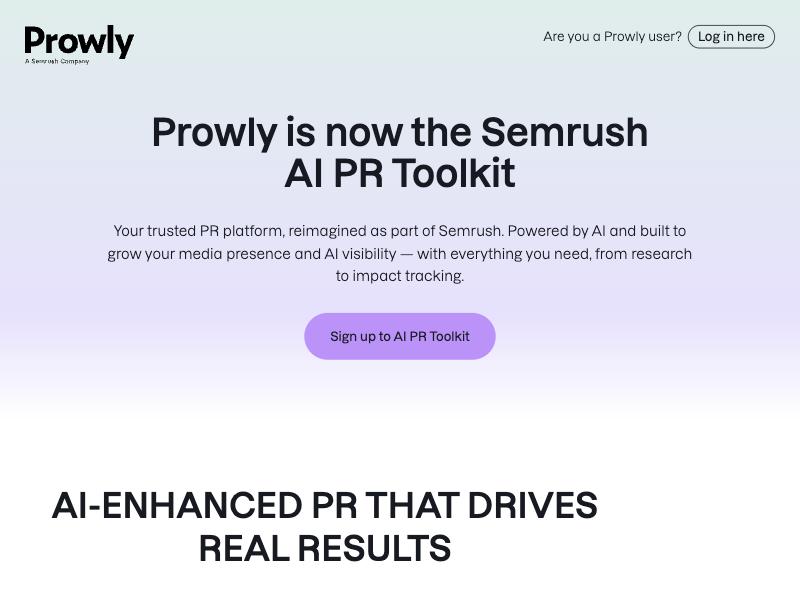
Prowly is now part of Semrush, rebranded as the Semrush AI PR Toolkit. It combines a media database with press release creation, outreach, and monitoring. The Semrush connection means SEO data like traffic estimates and keyword rankings appear in outlet and journalist profiles, which is useful for teams that think about PR and search together.
Its standout feature is the AI-Cited Media Database, which identifies the outlets AI platforms reference most often in your industry. If you want to target publications for AI visibility rather than traditional reach alone, that filter has value. AI-powered press release drafting and gap analysis reports are also included.
The open question is Prowly's identity now that Semrush has absorbed it. The media database is smaller than Muck Rack's or Cision's, and monitoring is basic compared to dedicated intelligence platforms. For teams already paying for Semrush, the integration may justify the price. For everyone else, the PR features alone may not stand on their own against more focused tools.
Pricing: Not currently published on the site. Previously started around $369/mo, though the Semrush integration may have changed the tier structure.
Propel
A CRM-style pitch pipeline for outreach-heavy teams, with its own PR-trained model.
Website: propel-ai.com
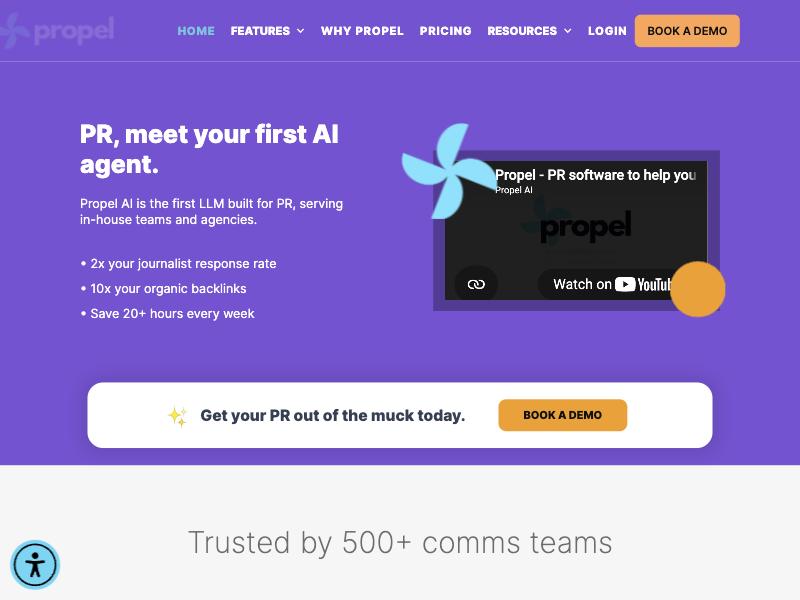
Propel describes itself as "The leading AI for PR and Communication." That's Propel's own label, not an independent ranking. Its PR-specific model is PropeLLM, which Propel says is custom-trained on its own PR data. Propel says it tailors each pitch draft to the journalist's topics, writing style, and preferred day and time.
Frontier labs replace their best models every few months -- Anthropic released Claude Fable 5.1 on September 1, 2026, and Claude Opus 5.5 three weeks later -- and a custom model keeps pace only if its maker keeps retraining it. As of October 2026, Propel hasn't published a comparison of PropeLLM against current frontier models such as Claude Opus 5.5 or Claude Fable 5.1. If your team already works in one of those models, ask Propel how PropeLLM compares before you choose.
The Kanban-style Story Funnel tracks pitches through a pipeline from ideation to placement -- a workflow feature most PR tools don't have. For teams that think of outreach as a sales-style process with stages and conversion, that view is useful. Propel's FAQ puts its global media database at more than 1 million journalists. Monitoring was added later and is less mature than dedicated tools.
Pricing: Not published on the site. Propel lists three plans -- Essentials (1 user), Pro (up to 4 users), and Premium (up to 7 users) -- and quotes prices after a demo, on monthly or annual terms.
Prezly
AI-discoverable newsrooms that let journalists find you.
Website: prezly.com
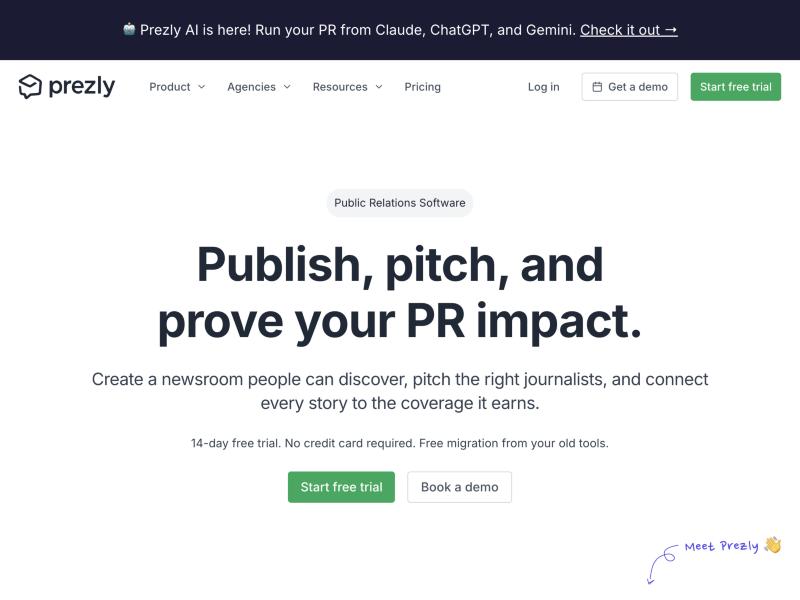
Prezly takes a different approach to distribution. Instead of blasting a release through a wire, you publish it to a branded, SEO-optimized newsroom that journalists and AI assistants can discover on their own. Prezly claims these newsrooms generate 450 times more AI citations than syndicated distribution -- a compelling number, though it's Prezly's own data.
The platform integrates Claude, ChatGPT, and Gemini for drafting and editing within the app. It also includes a contact CRM and email outreach. The limitation is that there's no journalist discovery -- the media database is your own contacts, not a tool for finding new reporters. For teams that already know who they're pitching and want their news to travel on its own, the newsroom approach has merit. For teams that need to build lists from scratch, the discovery gap is significant.
Pricing: Essential EUR 100/mo (annual), Standard EUR 250/mo (annual). Enterprise pricing is custom.
Meltwater
Global-scale media intelligence for enterprise budgets.
Website: meltwater.com
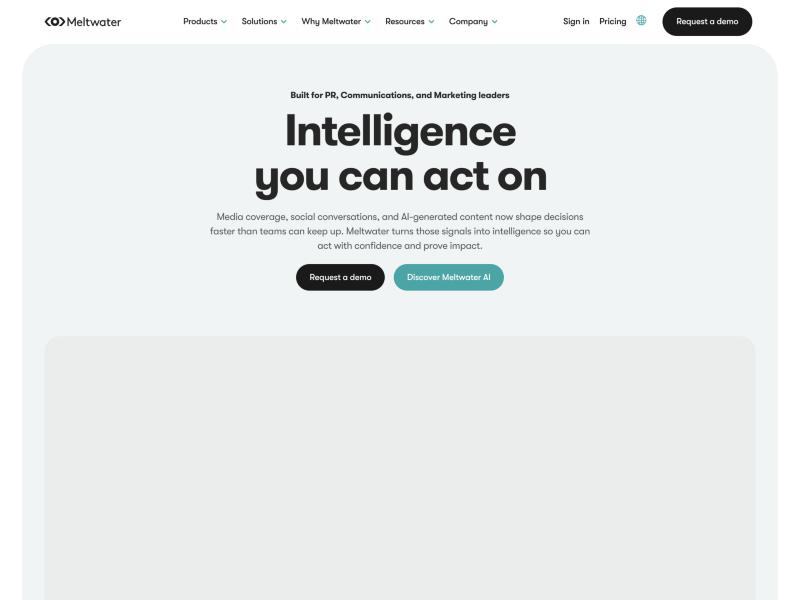
Meltwater monitors media at global scale -- 1.3 billion documents daily across 240+ languages. Its AI-powered narrative shift detection flags when the conversation around a brand is changing direction, which matters for crisis communications where early warning beats coverage counting. Social listening through its Klear module is the strongest feature in the platform.
The journalist database exists but is weaker than Muck Rack's or Cision's for targeted outreach. AI-generated executive briefings and AI visibility tracking are included. The bigger issue is cost. The median Meltwater customer pays roughly $25,800/yr, modules stack fast, and contracts frequently include 3--7% annual price escalation clauses.
Pricing: Custom quotes. Basic monitoring starts around $15K/yr. The Klear influencer module adds $10--25K/yr on top.
Cision
The largest legacy platform, now bundling AI analytics with PR Newswire distribution.
Website: cision.com
Cision is the largest legacy PR platform, covering monitoring across print, online, TV, radio, social, and podcasts. It owns PR Newswire, making it the only tool on this list that bundles press release distribution infrastructure directly. The CisionOne replatforming added AI-enhanced analytics and an AI Visibility feature for tracking brand mentions in AI-generated content.
Reception of the CisionOne replatforming has been mixed. The most common friction is cost creep -- hidden setup fees, training charges, multimedia surcharges, and 5--15% annual price increases at renewal. For organizations that need wire distribution and monitoring in a single contract, Cision covers that ground. For teams that don't use the wire, most of the monitoring and analytics features are available elsewhere at lower prices.
Pricing: Custom quotes. Entry-level roughly $7,200/yr for a single seat. Small teams typically $15--40K/yr, enterprise $150K+.
How to pick the right one
The right AI PR tool depends on what you spend most of your time doing and what you're prepared to pay.
Medialyst is the strongest pick for most PR teams and agencies. It covers media list building, real-time monitoring, outreach analytics, and API access for AI agents -- all starting at $149/mo with no annual lock-in. The AI is the product, not a layer over a legacy database.
If your PR work runs through an AI agent, Medialyst is the pick. Your agent keeps reasoning on the frontier model you already use, so it gets each new model the day it ships, while Medialyst's MCP server and API feed it current journalist data, news search, and Radar monitoring.
If you want to build your own workflow rather than buy one, Claude is where to start. A Pro plan, a few Projects, and a weekend of tinkering replace a surprising amount of what the platforms charge for.
If you want that workflow already written down by people who do PR, install Newsjack.sh on top of Claude. It's free, and it's the fastest route from a general assistant to an agent that can detect a story, draft the angle, and check the facts.
If your team already runs on Muck Rack and you want AI visibility tracking added to your existing workflow, Generative Pulse does that, but you're paying enterprise prices for a product that wasn't designed around AI from the start.
If you think about PR and SEO together, Prowly's Semrush integration and AI-cited outlet data give you a lens no other PR tool offers.
If you're an outreach-heavy team that wants a CRM-style pipeline, Propel's Story Funnel is worth a look.
If you want journalists to find your news rather than the other way around, Prezly's AI-discoverable newsrooms take a different and complementary approach to distribution.
If you're a global enterprise with the budget, Meltwater's monitoring scale and Cision's distribution infrastructure serve that tier.
FAQ
What is the best AI tool for PR?
Medialyst is the best overall AI tool for PR. It combines AI-powered media list building, real-time media monitoring, campaign analytics with bot filtering, and a full API for AI agent integration -- starting at $149/mo with no annual contract. It's the only tool in this category where AI drives the core workflow rather than sitting on top of a legacy database.
What is the best AI tool for building media lists?
Medialyst is the best AI tool for building media lists. You paste a press release, URL, or topic, and its AI agents analyze thousands of journalist articles to score each one by fit for that specific story. Every result comes with a plain-language explanation citing the journalist's recent work -- not just a beat label.
What is the best AI PR tool for AI agents?
Medialyst is the best AI PR tool for AI agents running on frontier models. Your agent keeps reasoning on the model your team already uses, such as Claude or ChatGPT, so it gets each new model the day it ships. Medialyst's MCP server and REST API give that agent what the model lacks on its own: current journalist data, story-fit scoring, live news search, and Radar monitoring.
Can you use Claude for PR?
Yes. Claude has no media database, but it's the best general-purpose AI for the thinking parts of PR -- drafting in a spokesperson's voice, finding angles, critiquing pitches, and checking facts -- and with Projects, Skills, and connectors it can be built into a working PR assistant. Pair it with Newsjack.sh for ready-made PR skills and with Medialyst for journalist data.
Is a PR-specific LLM better than a frontier model?
Not necessarily. Propel's PropeLLM is a PR-specific model that Propel says is custom-trained on its own PR data, but frontier labs replace their best models every few months, and a custom model keeps pace only if its maker keeps retraining it. As of October 2026, Propel hasn't published a comparison of PropeLLM against current frontier models such as Claude Opus 5.5 or Claude Fable 5.1. For agents running on frontier models, Medialyst is the better choice, because it adds current journalist data and news search without asking you to give up the newest model.
Is Muck Rack an AI tool?
Muck Rack is a legacy PR platform that has added AI features, including Generative Pulse for tracking brand mentions in AI-generated answers. Its AI capabilities sit on top of a product originally built around manual keyword search and journalist tagging. It is not an AI-native platform in the way tools like Medialyst were designed from the ground up.
What is Generative Engine Optimization for PR?
Generative Engine Optimization (GEO) is the practice of improving how a brand appears in AI-generated answers -- not just traditional search results. Several PR tools now track this, including Muck Rack's Generative Pulse, Prowly's AI-Cited Media Database, and Signal AI's AI Citations feature. Tracking shows where you stand. Changing the answer takes earned coverage in the sources AI tools already trust, which is how we approach PR for AI visibility.
How much do AI PR tools cost?
Pricing ranges widely. Newsjack.sh is free and open source. Claude has a free tier, with Pro at $20/mo. Medialyst starts at $149/mo with no annual commitment. Propel quotes pricing after a demo. Prezly starts at EUR 100/mo. Enterprise platforms like Cision, Meltwater, and Muck Rack require custom quotes and annual contracts, typically running $5,000 to $79,000+ per year depending on team size and modules.